Tag Archive for: Review

Posts

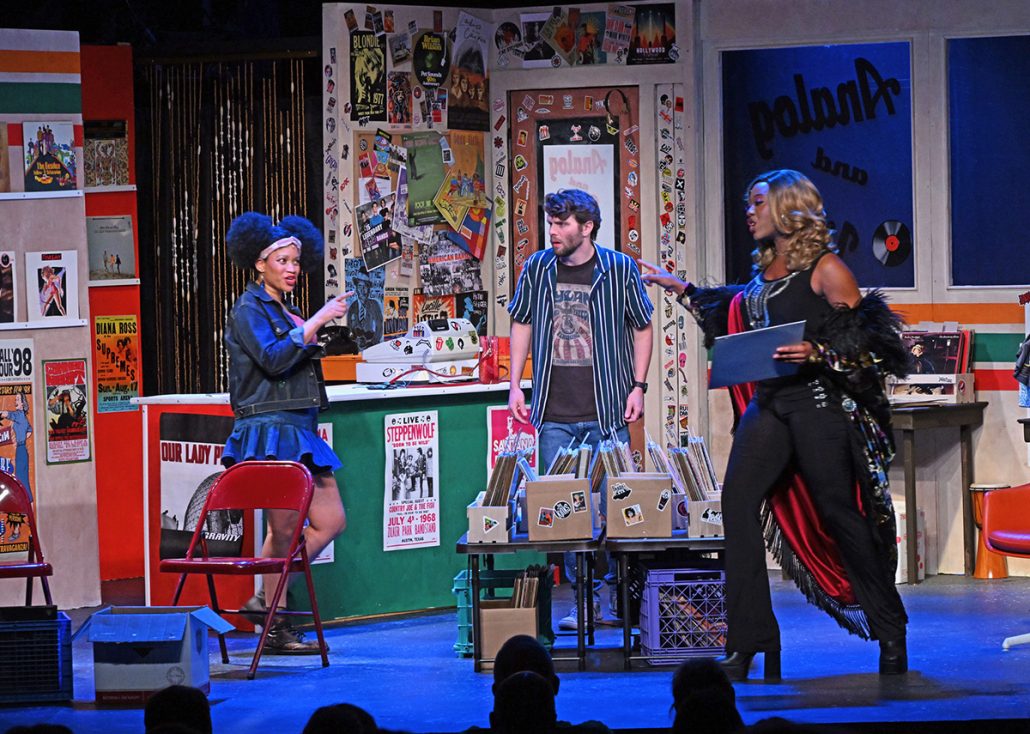
Tiara Whaley, Peter Corley, and Aja Downing in the Depot Theatre’s ANALOG AND VINYL.

A strength of the Depot is its perfect pitch for knowing when to poke smoldering social issues and when to let sleeping dogs lie. There are so many eye-averting troubles we must confront today at every turn that the luxury of escapism feels to be just what we needed.

Analog and Vinyl is a light and welcome beach-read of a musical that asks little of us, except that we sit back and enjoy an evening free of worldly encumbrances.

The scene of Analog and Vinyl is a vintage record shop operating out of a defunct convenience store, and from the get-go the set makes us happy — nostalgic posters of Steppenwolf and such, papering over walls that retain the garish 7-Eleven color scheme.

This is the lonely stamping grounds of the stressed Harrison, played by Peter Corley, whose lot in life is a blind devotion to the pressed albums of old that have lost out to the inferior but more convenient strains of the digital world.
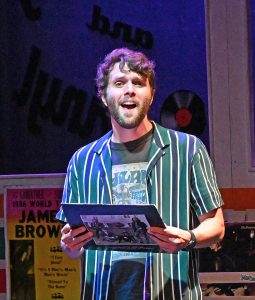
Peter Corley

Corley aptly channels his inner Eeyore while still maintaining an appropriate hint of optimistic light (not an easy balancing act, but Corley pulls it off), by way of a stone cold assurance that one of these days the unwashed masses will see the error of their ways and come flocking to his store for LPs. (We in 2024 America know that, theoretically, he was right, and somehow this knowledge makes Harrison both more endearing and situationally valid.)

Helping Harrison in the shop, or trying to, is the air-headed Rodeo Girl (Tiara Whaley) who is a bubbly, amusingly difficult to explain presence. Though the plot of Analog and Vinyl is a bit uneven in spots, we’re all having fun so it can remain an article of faith that loose ends will eventually be tied and inconsistencies reconciled, at least close enough for a rom-com.
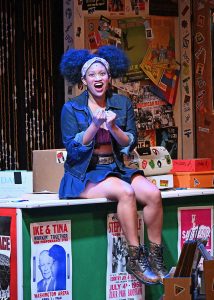
Tiara Whaley

Whaley skillfully takes a puzzling character and layers on complexities that grow as the show goes on, culminating in A&V’s best moment, Whaley’s rendition of “Vinyl Boy,” which brings down the house.

But the most delicious role of The Stranger is saved for the superb Aja Downing, who knows exactly what to do with a choice part. Of course you can’t spell “stranger” without s-a-t-a-n, and sure enough, the stranger has an offer that Harrison and Rodeo Girl can’t refuse. Or can they?
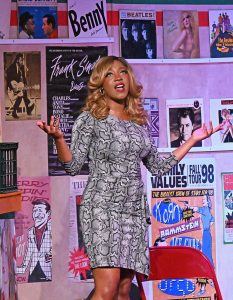
Aja Downing

As the two wrestle with their difficult decisions, more of their veneers crumble away and reveal tear-shedding vulnerabilities that make us feel far different about them than when they started out.

Director Beth Glover keeps the show hopping with levity until the plot can build momentum of its own. Also keeping toes tapping is a talented orchestra — Jane Boxall on drums, Bill Stokes on bass, and Andy Tompkins on guitar, with keyboards and music direction by Valerie Gebert — playing a lively score that is kind of essential to a show about a record shop.

THE ORCHESTRA –  (L-R) Valerie Gebert, musical director and keyboards; Andy Tompkins, guitar; Jane Boxall, drums; Bill Stokes, bass.

All told, the show leaves us far happier than when we came in, and not many diversions today can make that claim. Circumstances being what they are, the Depot’s Analog and Vinyl is a refreshing oasis from our cares in a day and age when, for a little carefree fun, we might even sell our souls.

Tim Rowland contributed this review by the request of, and in collaboration with the Depot Theatre. Rowland is a journalist and New York Times bestselling author, whose humorous commentaries explore an eclectic variety of subject matter, from politics to history to the great outdoors. He and his wife Beth live on the Ausable River in Jay, N.Y.

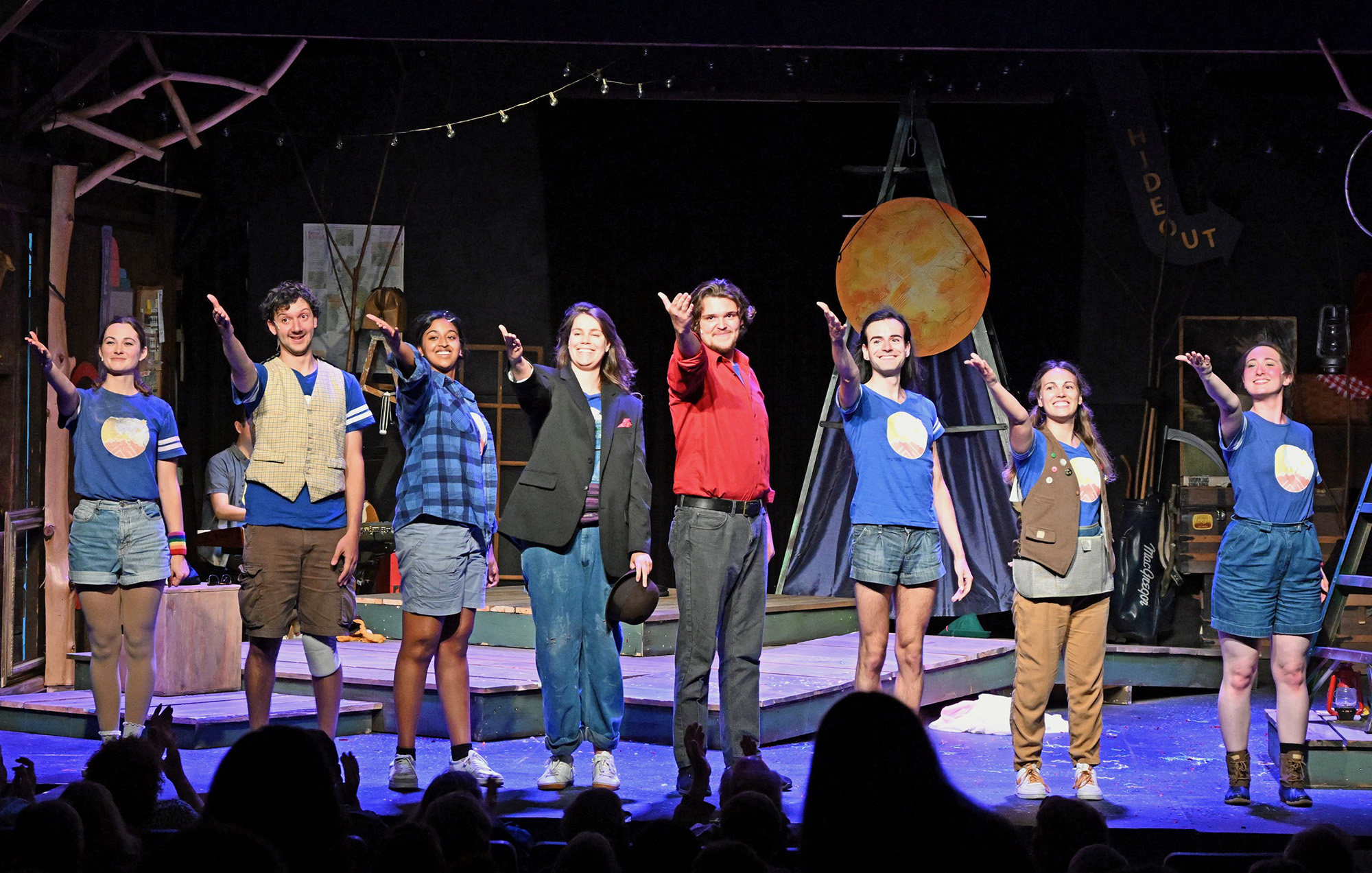
The cast of the Depot Theatre’s production of THE FANTASTICKS (L-R: Cassidy Sledge, Sam Balzac, Isha Narayanan, Amanda Giles, Zach Monczewski, James Rose, Rebecca Lee Whitcomb, Madeline Saintsing.)


THE FANTASTICKS, the comforting theatrical equivalent of ordering the same thing at the restaurant you always do, has not been around forever, although it may seem that way. Debuting in 1960, the musical proceeded to go on an historic, 42-year off-Broadway run, while becoming almost a legal requirement for every high school and community theater in the land. But don’t go to the Depot Theatre’s take on THE FANTASTICKS (running through Aug. 27) expecting the same-ole same-ole. Read more

Luke Wehner in the Depot Theatre’s production of CHESAPEAKE.

What is art, anyway? Your dog knows.

Long before this thing called woke, long before we had come to understand that all the world’s problems could be solved with pronouns, there existed a simpler time in which culture-war villains had real brick-and-mortar office buildings with actual staff and budgets funded by hard-working, god-fearing taxpayers. Read more

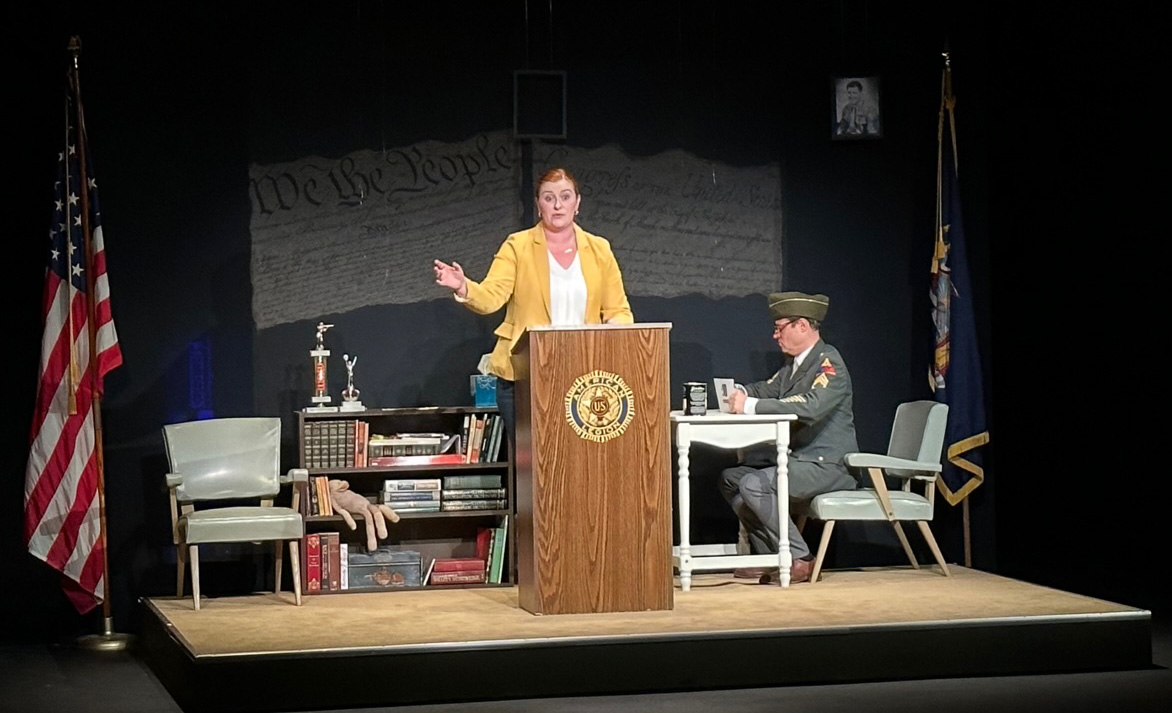
Kayla Ryan Walsh and Michael J. Connolly in WHAT THE CONSTITUTION MEANS TO ME at the Depot Theatre.


Looking back, 2019 was a simpler time, when all that human-rights advocates had to worry about were sexists, racists, homophobes, and domestic abusers. So much historical water has flowed beneath our constitutional bridges since then that the list of socio-political threats we need to concern ourselves with has grown almost as lengthy as the Constitution itself.

If anything, that adds a wallop to Heidi Schreck’s What the Constitution Means to Me, which opened this weekend at Depot Theatre, featuring Kayla Ryan Walsh as Heidi — the real-world actor who starred in her own production, which opened on Broadway just four short years ago. Read more

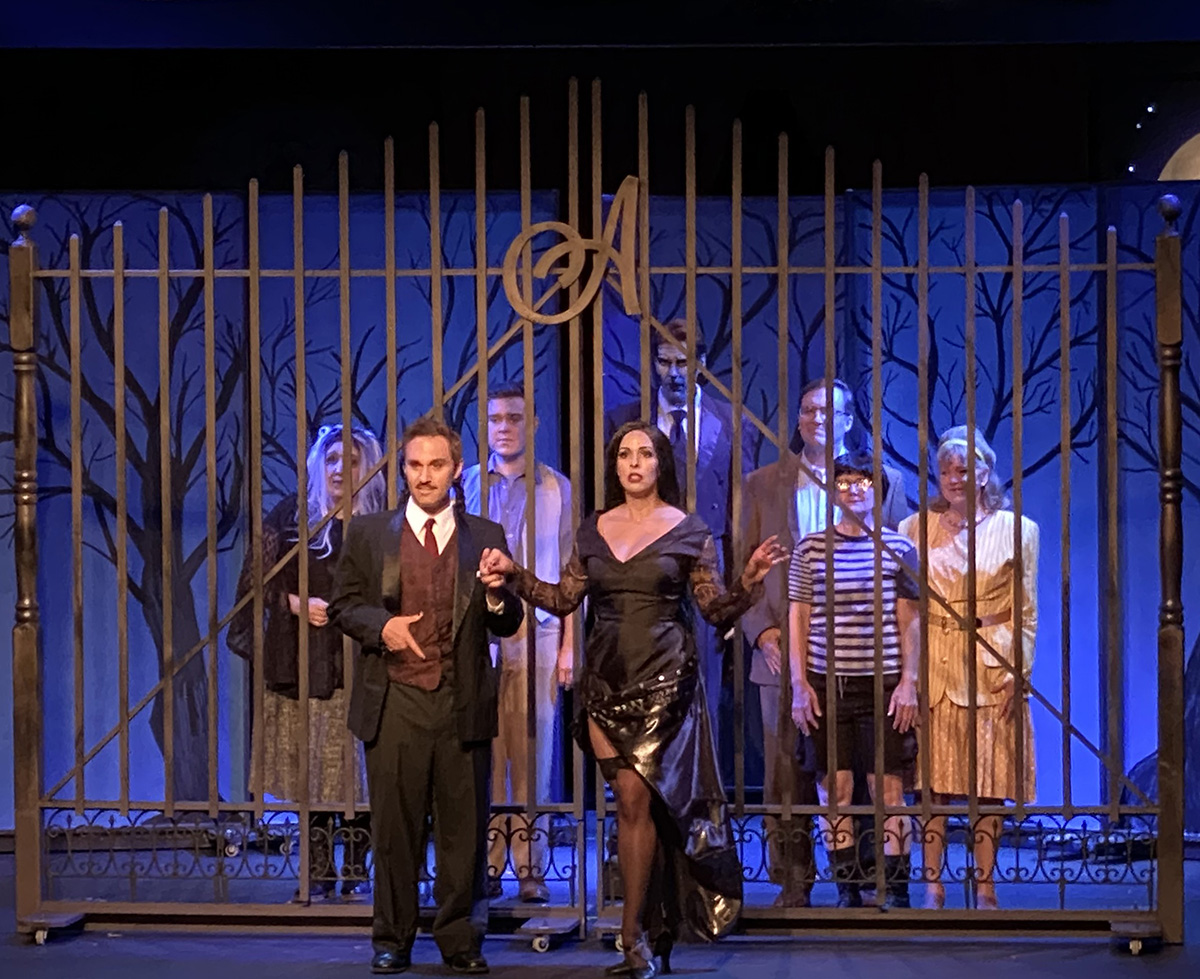
The Depot Theatre’s production of THE ADDAMS FAMILY: A NEW MUSICAL is on stage through August 28, 2022.


The Addams Family brand just won’t die. But of course.

Born in 1938 as a series of one-panel cartoons, this ghoulish family has lived through the generations as cartoon, TV show, film, video game, dance move, and musical comedy.

Broadway critics tried to drive a stake through the family’s heart a dozen years ago when the original Addams Family musical was introduced, with reviews filled with what cast members called “absolute cruelty and vitriol.” Gomez and Morticia would have approved.

But critics and paying customers didn’t, and the production was hastily retooled, after which it rose from the dead and became a nationwide hit. Read more

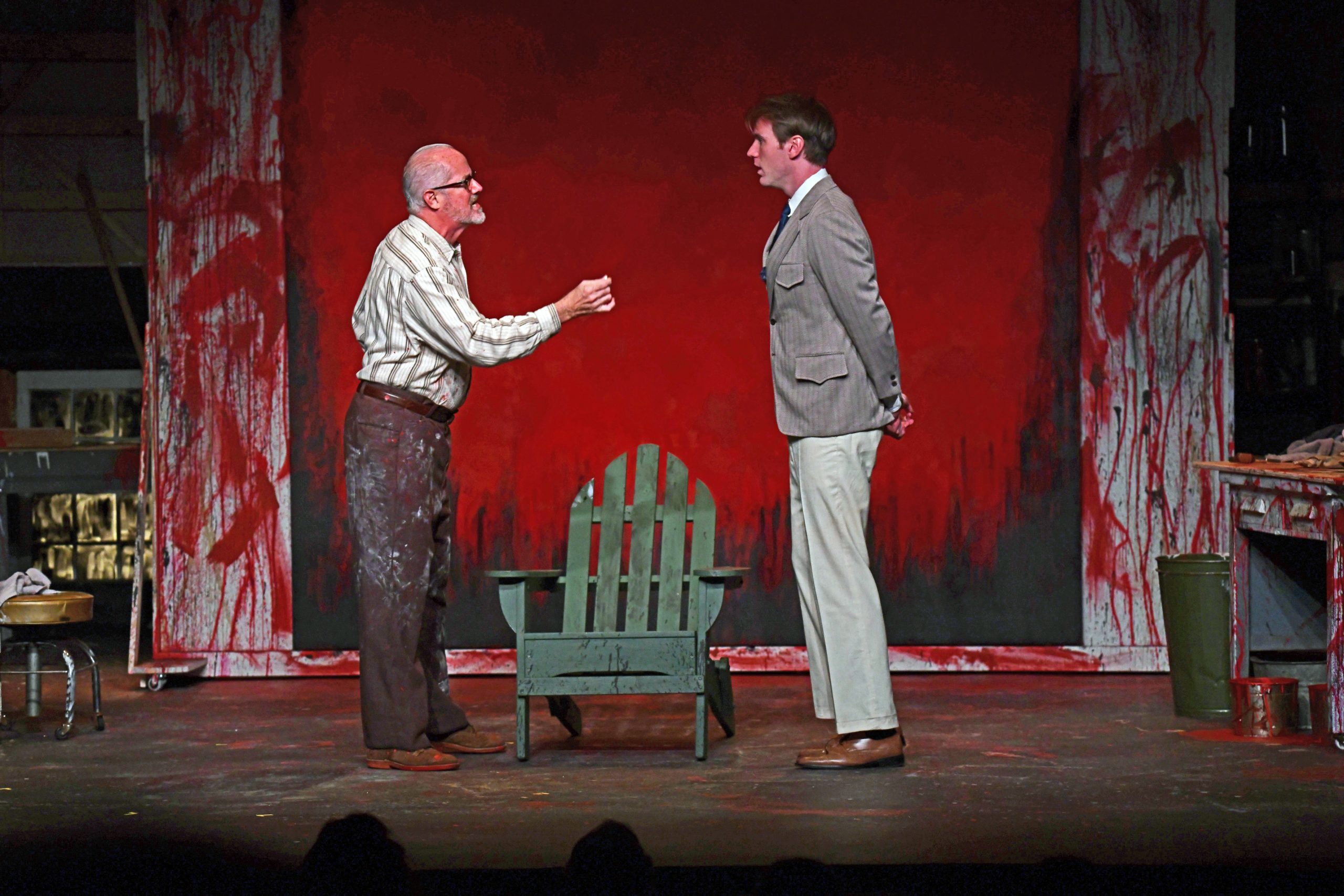
Jeff Williams (L) and Michael Glavan in the Depot Theatre’s production of RED by John Logan.


There’s not too much about pretentious artists that hasn’t already been explored, but even by the breed standard, abstract expressionist Mark Rothko — as depicted in John Logan’s Red — takes the cake.

“I’m fascinated by me,” Rothko (played by Jeff Williams) chirps in the Depot Theatre’s second production of their 2022 season. The thing is, we’re fascinated by him too, as he rants, browbeats, erupts, interrupts, insults, and self-glorifies his way through two years spent in his Bowery studio in the late 1950s. Read more

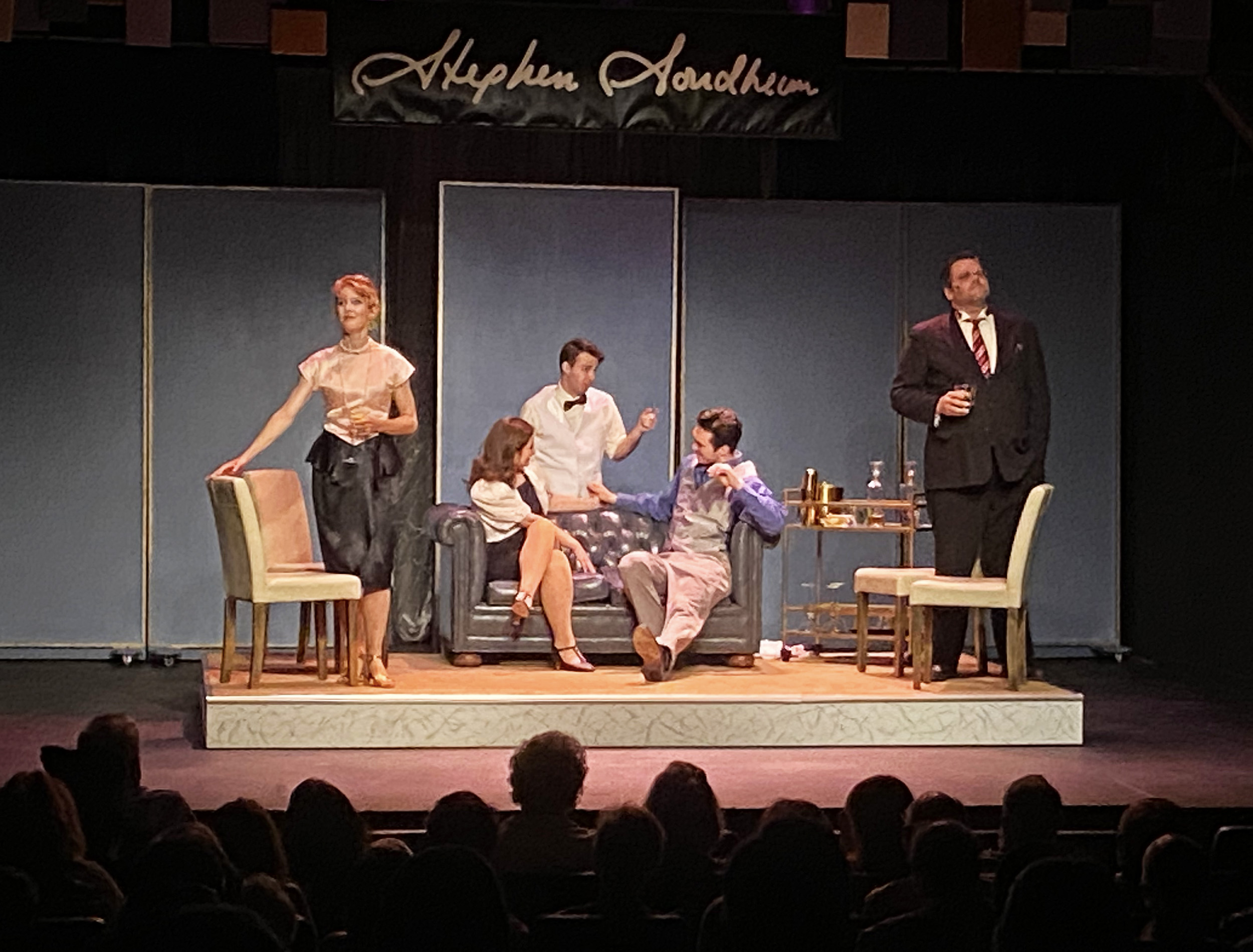
The cast of Depot Theatre’s production of PUTTING IT TOGETHER (L-R: Elisa Van Duyne, Lauren Gunn, Hunter Nichols, Roman Matusiewicz, Adam Michael Tilford.)

Stephen Sondheim was, by acclaim, the best composer/lyricist of the latter half of the 20th century, his name up on the marquee of Broadway titans along with Irving Berlin and Cole Porter. Sondheim died last fall at the age of 91, and in tribute, the Depot Theatre in Westport opens its 2022 summer season with PUTTING IT TOGETHER, a musical revue that cleverly spins a story out of songs plucked from a cross section of Sondheim’s copious canon.

If the story itself is a bit hackneyed — money can’t buy love — it scarcely matters any more than a plain tablecloth beneath a sumptuous Sunday brunch. It’s the musical fare that is important, and TOGETHER is a hearty compendium drawn from some of Sondheim’s most notable shows. Read more

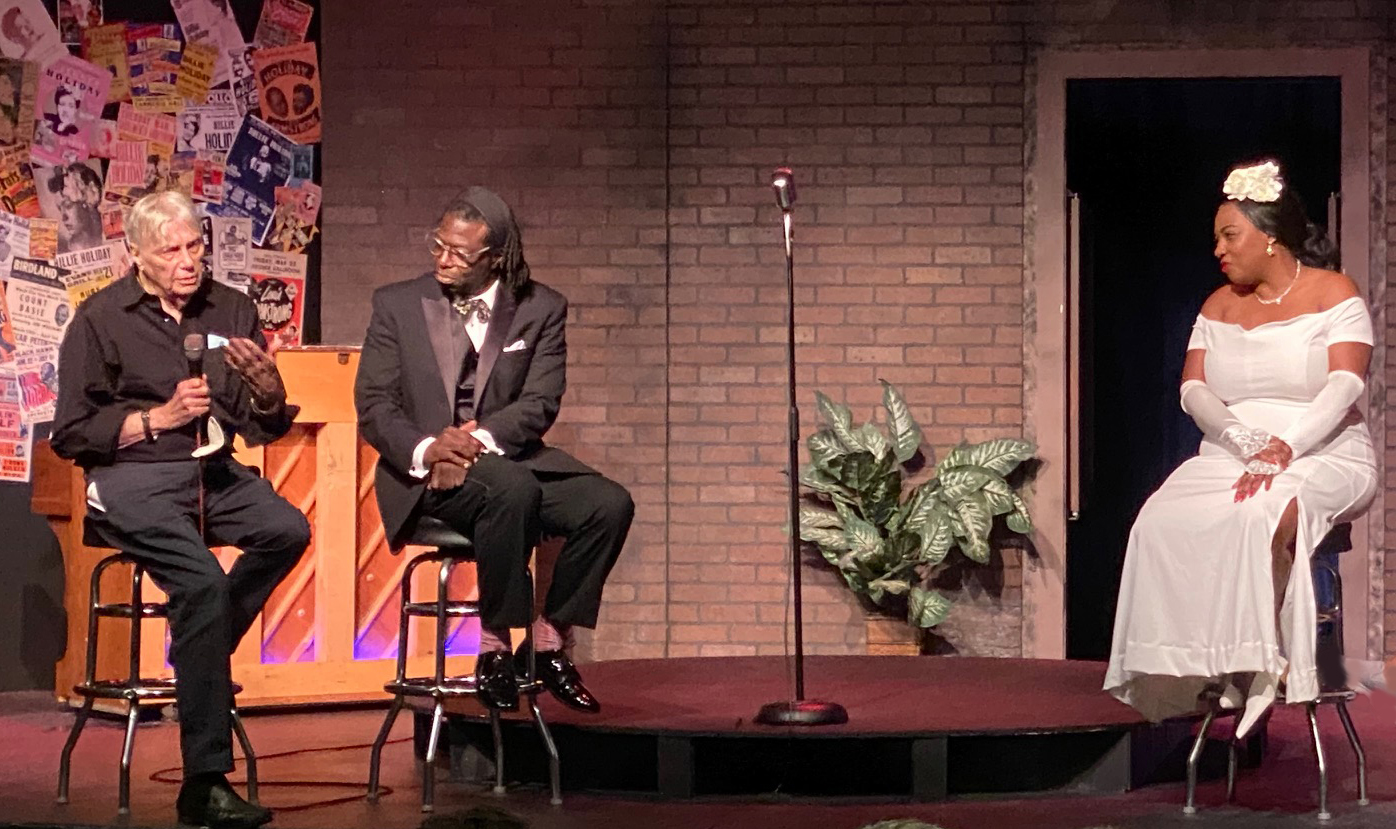
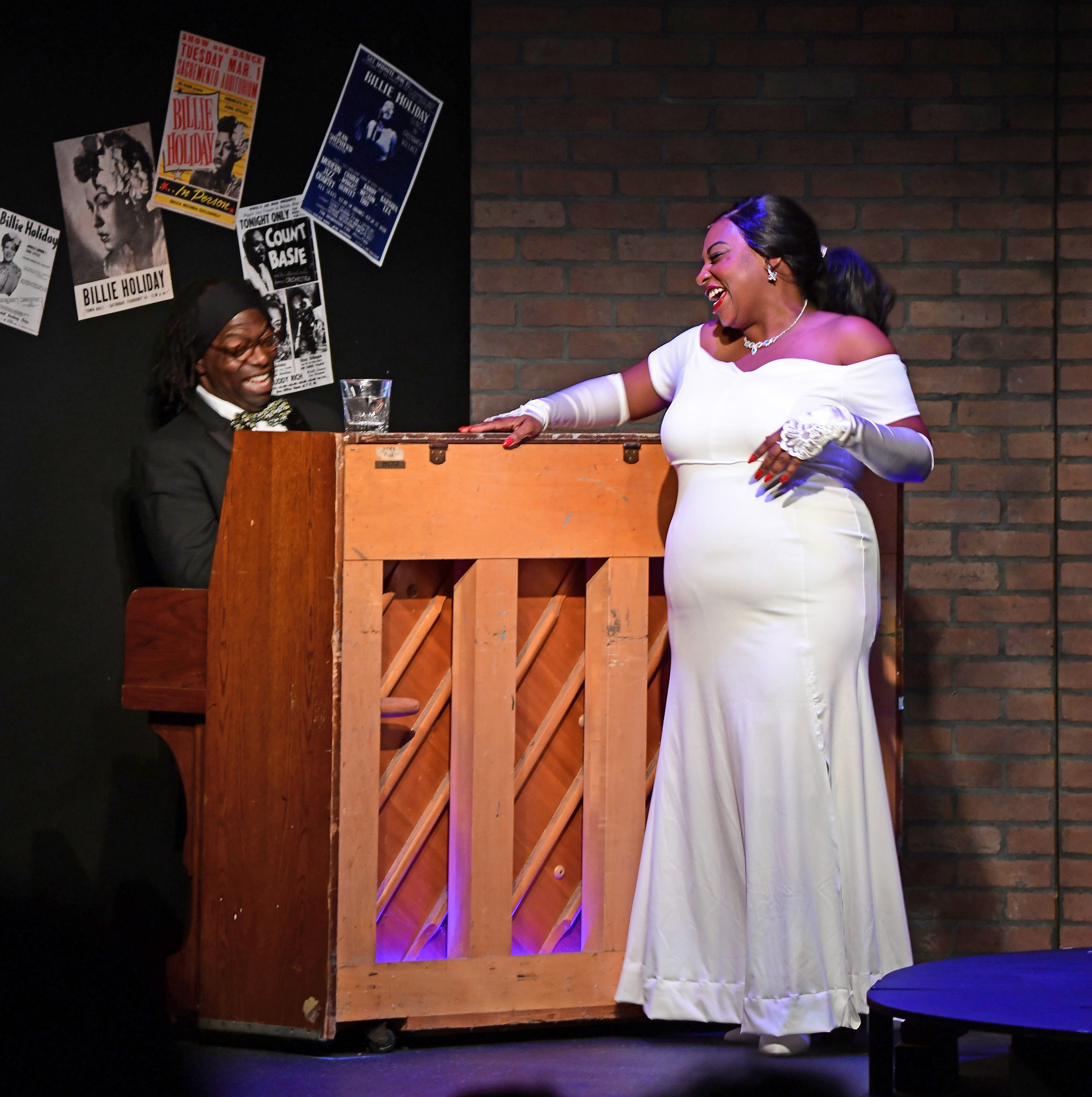
Playwright Lanie Robertson (L) joins actors Darnell White and Anna Anderson after a performance of LADY DAY AT EMERSON’S BAR AND GRILL at the Depot Theatre.

By Tim Rowland

The subset of the American population who remember Billie Holiday in her prime is precipitously dwindling, meaning we are more likely to remember her music, but not her.

Some might argue this is for the best. Even in the lengthy canon of artistic tragedy, the woman born in Baltimore in 1915 as Eleanora Fagan takes the cake.

Lying on her deathbed, she was under police guard, as if the emaciated, scarcely conscious figure under the sheets, with few remaining friends and 70 cents in the bank would rise up and do — what, exactly?

Holiday died in 1959 at age of 44, her liver finally calling it quits after a life of drugs and drink. Yet her talent was not in dispute. At the tail end of the jazz age, she patterned her voice after the sassy trumpet strains of Louis Armstrong, creating a memorable sound that sold out Carnegie Hall and earned her a trophy case full of honors — most of which were bestowed upon her after she was dead.

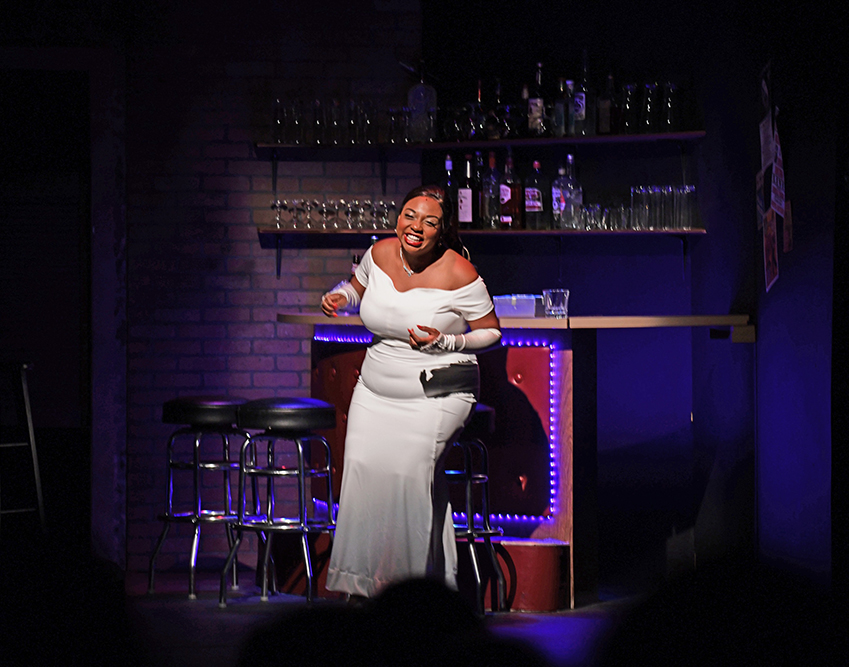
The Depot Theatre examines her life in Lanie Robertson’s Lady Day at Emerson’s Bar and Grill, a play that debuted 32 years after Billie Holiday’s death. Set in a small club in March 1959, just months before she died, Lady Day is but a shell of the “old Billie” who was the Diana Ross or Nicki Minaj of her day.

Holiday, at first glance, might seem to herald the lives of Morrison, Joplin, Cobain, and Parsons, whose back stories often seem just shallow and sad if they seem anything at all.

But Depot Theatre artistic director Kenney Green is not in the business of exploring the mundane. Billie Holiday’s tortured existence played out against a backdrop of nightmarish racism and abuse, as opposed to more modern-day, privileged young rock and rollers, who can be thrown into deep depression if their allowance is late.

The reins of this show are placed in the eminently capable hands of Anna Anderson, who has brilliantly mastered the tones and inflections that made Billie Holiday’s voice so memorable and interesting, if not classically great. Anderson’s rendition of this playlist of songs stand on their own for Billie Holiday fans, but of course there is a lot more to the story.

Billie takes the stage unsteadily, supported by her pianist Jimmy Powers, played by Darnell White. As Jimmy takes his seat behind the piano, Billie cuts her eyes to him in fear, seeking assurance that the night will turn out all right, which of course it will not. This vulnerable glance might be the last we see of the real Billie before the booze starts doing the talking and the birdsong of her spine-tingling hits is interrupted more and more often by rambling sojourns into the past.

In a beautifully understated performance, White’s Jimmy lets us know that, most likely along with everyone else, he’s just about had it with Billie.

He wants the act to succeed, but he senses that ultimately it won’t — when Billie makes it triumphantly through the end of a song, his face reveals the terrified giddiness of one who has just managed to land an aircraft blindfolded.

Maybe out of respect, maybe because she’s his meal ticket, Jimmy does his best to hold the act together, enabling Billie’s addictions by making up a medical excuse when she flounces off the stage, and covering up the needle marks on her arm after she’s returned from shooting up. At one point he tries to do a little CPR on her mood, encouraging her to sing one of the old “good time songs.”

Anderson’s boozy Billie doesn’t really care what Jimmy thinks, and she makes no particular effort to make the audience like her, either. It’s way too late in her bruised and addled life for that.

While we feel pity, and maybe sympathy, for Billie, it stops there. For such a sad tale, there are no poignant moments that cause the eyes to well, or times when you want to put your arm around Billie and tell her “there there,” or, as Robin Williams repeated to Matt Damon in Good Will Hunting, “It isn’t your fault.”

It is only on this realization that we notice something else: When we see Billie Holiday, we are not seeing a Black musician, we are seeing the reflection of a thousand ugly abuses perpetrated by a racist White nation that have hardened her soul like bitter steel to the point where not even her humanity can shine through.

She recounts many of these incidents, but laughs them off, or frames them as jokes — “I’m kidding, I’m kidding,” when you know she is not, as evidenced by her selection of “Strange Fruit,” a song about Southern lynchings so searing that in her real life shows it was saved for last so she could be quickly hustled away from the venue, if necessary.

Lady Day leaves us with a lot of sorting out to do. It blames her addictions not on white people, but on a destructive relationship with a man who asked her to shoot up to prove her love. Without children, she had nothing to nurture. Her only solace is song.

In the end, as she is plunging into the depths that are about to claim her life, we root for Billie to gather herself, to pull it together, to stick the landing one last time like the “old Billie” belting out one of her hits. Because that’s what we care about. If only we had cared more about her.

——————–

Tim Rowland contributed this review by the request of, and in collaboration with the Depot Theatre. Rowland is a journalist and New York Times bestselling author, whose humorous commentaries explore an eclectic variety of subject matter, from politics to history to the great outdoors. He and his wife Beth live on the Ausable River in Jay, N.Y.

“WORKING’s goal is to elevate the worker, making us see the person instead of the job.”

Kenney Green (center) drives the number “Brother Trucker” along with Xavier Reyes (L) and Terry Lewis in Depot Theatre’s WORKING: A MUSICAL.

The Depot Theatre had planned its production of the Broadway musical Working back in the dark ages of 2020, which was only one year ago, yet in some ways seems like a million. 

As live theater was succumbing to COVID regulations last summer, it would have been impossible to forecast that Working would in some ways be a beneficiary, since its granular examination of the American labor scene has become wildly relevant in the meantime.

WORKING is based on a book by Pulitzer Prize-winning author Studs Terkel, who, before oral histories were really a thing, let average employees tell their own stories in their own words.

His 1974 book “Working: People Talk About What They Do All Day and How They Feel About What They Do,” explored a broad cross section of jobs, from the thrilling to the mundane, and, if you squint hard enough, you can see some seeds of what has come to pass some half-century later.

Between 2020 and 2021, the modern-day labor force has been transformed, or if that’s too strong a word, at least shaken to its core by too many unsatisfying jobs chasing too few people who are still willing to do them.

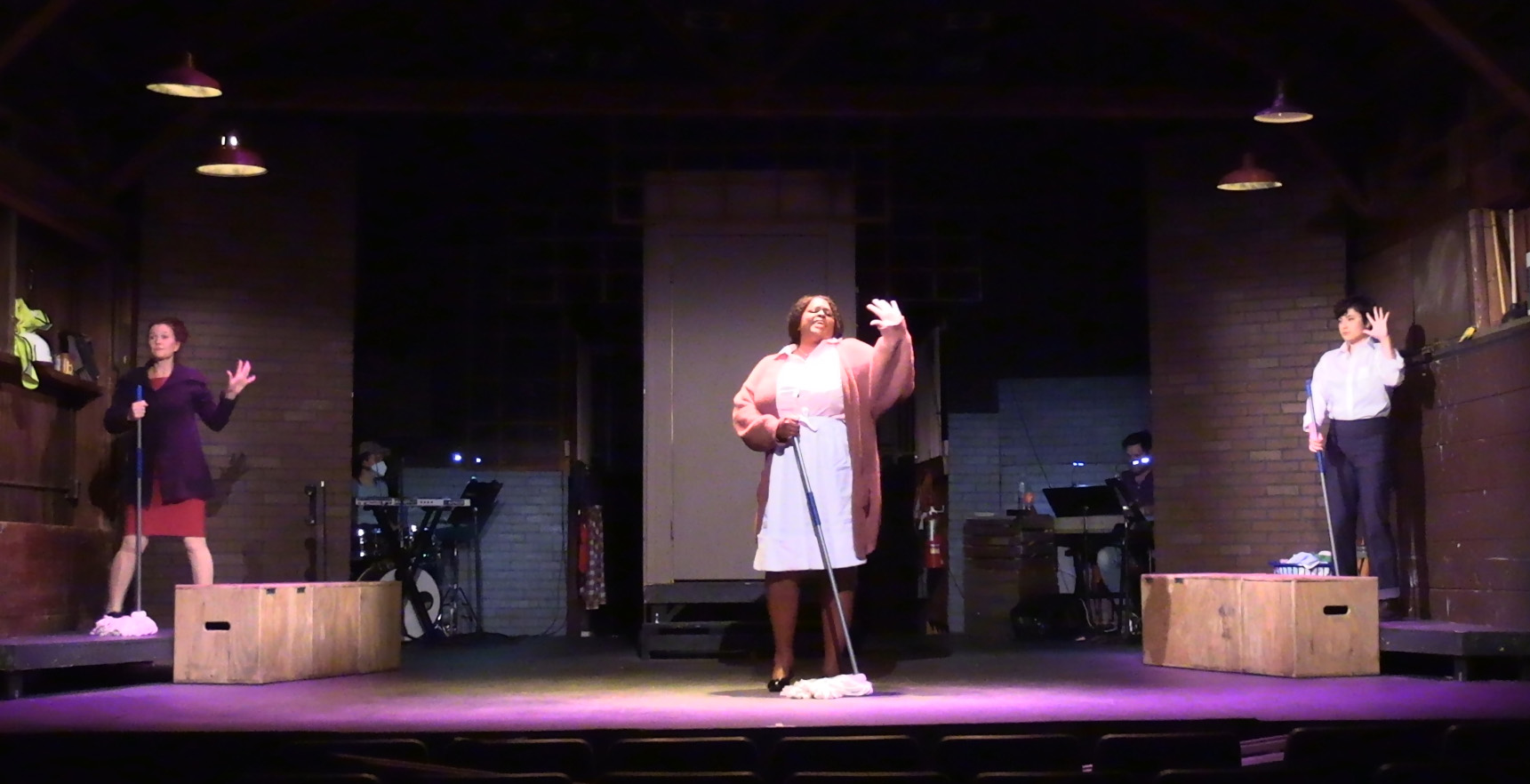
Brandi Massey (center) raises the roof in her role as a cleaning lady.

Kenney Green, producing artistic director for the Depot Theatre, likes to choose works that have social relevance, and events of the last 16 months have given WORKING just that, and then some. Laments that are 50 years old sound perfectly fresh today. Art has figured out a puzzle that has bedeviled science.

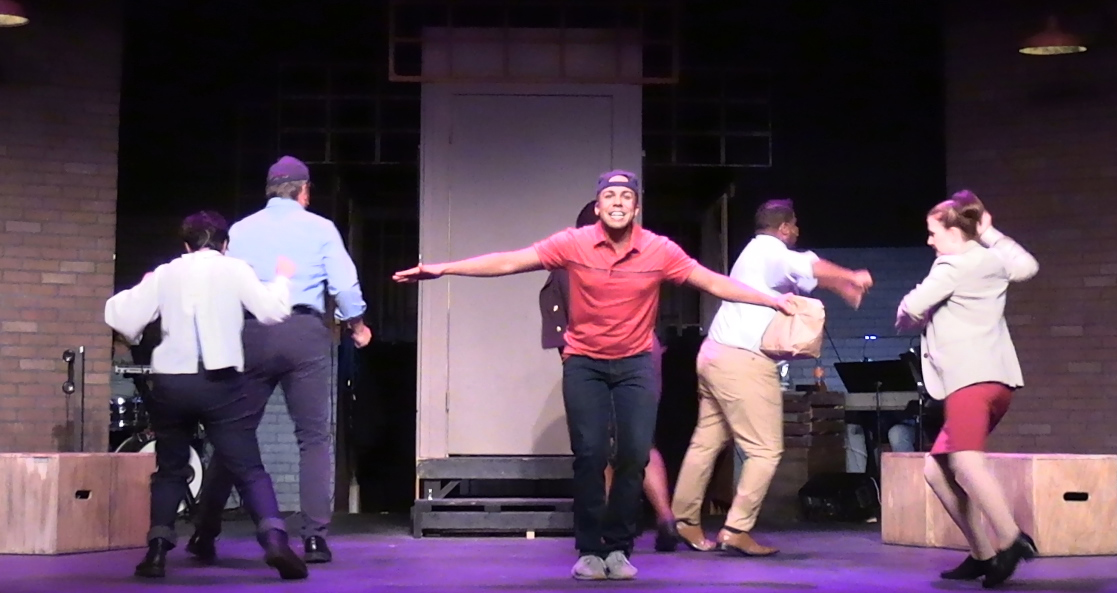
Director Julie Lucido takes full advantage, giving the production a poignancy fitting with the times. Xavier Reyes, who is delightfully funny — young enough that the gravity of a dead-end job seems not to have quite registered yet — plays fast food worker Freddy Rodriguez, as the remaining cast runs in circles delivering meals in cat-chasing-tail fashion, giving a distinctly modern feel to a show that, at its inception, could never have anticipated Uber.

Xavier Reyes plays a delightful fast food worker in WORKING: A MUSICAL.

WORKING requires actors to step into multiple roles, representing jobs that are primarily, but not exclusively, the type we think of as being low pay and low reward. This can be tricky, but the cast never misses a beat — Terry Lewis, for one, is just as convincing as a hedge fund manager as he is an ironworker.

Terry Lewis as an iron worker in WORKING: A MUSICAL.

These scenes play off each other and blur the lines of what we might think of as legitimate and illegitimate careers. From across the stage a fundraising socialite (Amy Fitts) and sex worker (Brandi Chavonne Massey) ruminate on their careers in a way that leaves us wondering which really has the worse end of the deal.

Terkel’s book was published long before the modern day political catchphrase “dignity of work,” but as the laborers tell their stories, dignity, or at least a sense of recognition, is what they seek. It is hurtful to be thought of as “just” a laborer, or “just” a waitress.

Amy FItts (center) as a waitress in WORKING: A MUSICAL.

As a peppery waitress who wants to excel, Fitts soars in dance, her heavy black shoes the only reminder that for most of us, her job is anchored to the ground in thankless drudgery. When Green, who takes the stage himself in this production and is central to two of the more memorable scenes, appears as a UPS driver, he cheerfully reports that it is the random topless sunbather who gets him through the day.

Yet when Green takes the role of retiree looking back on his life, his fulfilling memories are of the time spent with friends and family — work, not so much.

Maybe that’s for the good. WORKING shows the risk in being defined by one’s career. Fitts tugs at the heart playing the role of a pinched schoolmarm, whose eyes shine when she speaks of teaching children, then dull with confusion and bitterness at a world that has passed her by, as the old order of things, which included segregation and corporal punishment are no longer tolerated.

Thani Brant (R) leads the cast in repeating the mundane tasks of a factory worker.

So too does promising young actor Thani Brant make us wonder what is to become of the factory drone who is no more appreciated than a piece of equipment. Her laugh at her position is dry and mirthless, and she makes us feel the injustice of one who has reached a dead end at such a young age.

Still, WORKING never feels heavy or depressing. It is in the main a story of resilience, and of people who have faith in themselves even if no one else does.

The score of WORKING is not as memorable as longer lasting productions, but it has its moments, and when Massey starts to sing, time stops. Lucido’s choreography is notable, be it the light playfulness of those who have not been worn down by their work, or the heavy metal-on-metal robotics of those who have.

WORKING did not last long on Broadway, but perhaps the greater question is how it arrived there at all. More social commentary than mindless entertainment, at first blush it is almost as improbable as making show tunes out of Upton Sinclair’s The Jungle.

Yet without the art of music and dance, Terkel’s oral histories might sink of their own weight. WORKING’s goal is to elevate the worker, making us see the person instead of the job. Next time we encounter a waiter or a truck driver, instead of seeing a waiter or a truck driver we may instead see a life. And, as we have learned over the past year and a half, that’s what’s important.

——————


Tim Rowland contributed this review by the request of, and in collaboration with the Depot Theatre. Rowland is a journalist and New York Times bestselling author, whose humorous commentaries explore an eclectic variety of subject matter, from politics to history to the great outdoors. He and his wife Beth live on the Ausable River in Jay, N.Y.
[et_pb_section fb_built=”1″ _builder_version=”3.22″][et_pb_row _builder_version=”3.25″ background_size=”initial” background_position=”top_left” background_repeat=”repeat”][et_pb_column type=”4_4″ _builder_version=”3.25″ custom_padding=”|||” custom_padding__hover=”|||”][et_pb_text _builder_version=”4.4.6″ background_size=”initial” background_position=”top_left” background_repeat=”repeat” hover_enabled=”0″]

[This theatre review of “Greater Tuna” by Connie Meng was aired and published by North Country Public Radio as “Theatre Review: ‘Greater Tuna’ at the Depot Theatre in Westport NY” on August 04, 2014. Listen to the story.]

The two-man comedy “Greater Tuna” opened Off-Broadway in 1982 to rave reviews. It’s been an audience favorite ever since. It runs at the Depot Theatre through August 17.

Chan Harris as Mr. & Mrs. Bumiller, Trip Plymale as Jody & Charlene (Photo: Depot Theatre)

Chan Harris as Mr. & Mrs. Bumiller, Trip Plymale as Jody & Charlene (Photo: Depot Theatre)

“Greater Tuna” by Jaston Williams, Ed Howard and Joe Sears is a show that provides the opportunity for a tour de force by the two actors involved.  Amidst the laughs and giggles it has some pithy things to say.  Although it’s set in Tuna, the third smallest town in Texas, similar characters exist in rural areas throughout the country.  They just may not have that Texas drawl.

The framework for the piece is a local radio show hosted by Arlis Struvie played by Tripp Plymale and Thurston Wheelis played by Chan Harris, who also directed.  Through call-ins, interviews and commercials we meet several Tuna residents.  The two actors play town big-wigs and the members of a dysfunctional family – young, old, male, female, and even a very noisy dog.

Bonnie Brewer’s simple set of two tables with chairs and a big cabinet radio up center is backed by a nice three-part painting of east Texas fields.  Margaret Swick’s lighting is just fine.  I assume the multitude of costumes were a group effort and work very well.  Kudos to whoever’s backstage helping with the lightning fast changes.

Chan Harris is very good as Pearl Burras, local chicken farmer and dog poisoner.  I love the scene in the funeral parlor with Pearl’s serenade to the dead Judge and the comment, “You look so… waxy.”  As the energetic Reverend Spikes he gives a very funny eulogy made up entirely of platitudes and song lyrics.  He’s also excellent as Bertha Bumiller, harassed mother of three.  We know exactly how she feels about her husband when we watch her chop vegetables. By the way, he also plays her husband.

Mr. & Mrs. Bumiller, Jody & Charlene onstage (Photo: Depot Theatre)

Mr. & Mrs. Bumiller, Jody & Charlene onstage (Photo: Depot Theatre)

Tripp Plymale is terrific as snippy Vera Carp, head of the Smut Snatchers of the New Order who plan to clean up the high school dictionaries. Her reactions to Reverend Spikes are hilarious.  He’s excellent as gentle Petey Fisk, protector of lost animals including ducks.  Mr. Plymale gives all his characters unexpected depth and three-dimensional humanity.  This is especially so with the three Bumiller children: forlorn young Jody whose only friends are the dogs who follow him around, overweight Charlene, shy amateur poet and failed cheerleader, and fresh out of reform school Stanley, his edgiest character.  Stanley’s powerful scene with the dead Judge takes a sudden twist and ceases to be funny.

The juxtaposition of prayers in Act II is funny, chilling and touching by turns.  That of Elmer Watkins, NRA member, reminds us that bigotry isn’t always to be laughed at, while that of Petey Fisk is very moving.  Director Harris has also chosen great songs that perfectly set up the atmosphere.

“Greater Tuna” is a very funny play with some wonderful serious moments.  Mr. Harris and Mr. Plymale have brought out all the nuances of the piece.  Its mixture of affectionate comment and dark satire provides a solid evening’s entertainment at the Depot Theatre.

On a scale of one to five the Depot Theatre’s production of “Greater Tuna” gets four and five-eighths box cars.  For North Country Public Radio I’m Connie Meng.

(Theatre review via North Country Public Radio)

[/et_pb_text][/et_pb_column][/et_pb_row][/et_pb_section]